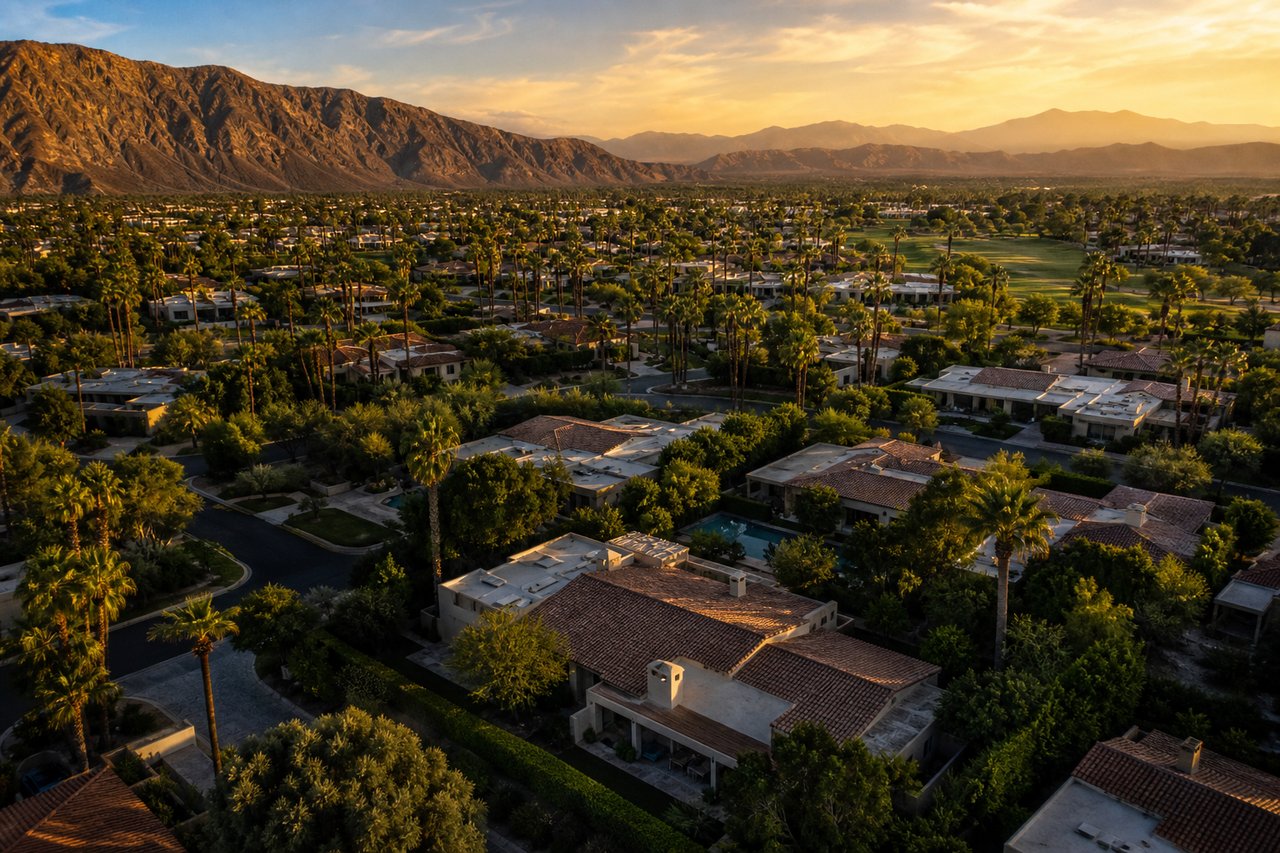
How does snowbird demand affect home prices and sales in Indian Wells?
Snowbird demand is one of the primary forces behind Indian Wells' elevated price point and seasonal transaction patterns. Recent local market data puts the area's median sale price at $1,575,000 with a median 51 days on market, well above the broader Riverside County median. Seasonal buyers, particularly those arriving from colder climates each fall, concentrate purchase activity in a narrow window, which means sellers who time their listings correctly and present turnkey properties capture the strongest offers. As of late summer 2026, a softening in some international snowbird flows has pushed inventory higher and given buyers more negotiating room than in prior peak years.
Key Takeaways
- Indian Wells carries a median sale price of $1,575,000, roughly 2.5 times the Riverside County median of $623,000, a premium driven in large part by second-home and snowbird demand.
- Recent local market data shows Indian Wells homes selling in a median of 51 days, with 63 active listings and 59 closed sales in the trailing 90 days as of September 2026.
- A November 2025 report documented a notable slowdown in Canadian snowbird participation across the Coachella Valley, contributing to higher inventory and more negotiation room heading into the 2026-27 winter season.
- As of mid-August 2026, 36% of active La Quinta listings had price reductions and 0% had price increases, signaling a buyer-advantaged environment across the resort corridor.
- Sellers targeting snowbird buyers need a different strategy than a typical primary-home sale: turnkey presentation, digital marketing that runs year-round, and pricing calibrated to out-of-area buyers who shop remotely before committing.
What does the current Indian Wells market actually look like for second-home buyers and sellers?
Indian Wells is not a typical residential market. It is a resort corridor where a meaningful share of buyers are purchasing a second home, a winter retreat, or an investment property they plan to occupy part of the year. That shapes everything: who is buying, when they are buying, and what they are willing to pay.
Recent local market data confirms the premium. Indian Wells sits at a $1,575,000 median sale price, more than double the Riverside County median of $623,000, which Redfin's Riverside County market data put at $623,000 over the three months ending July 2026. That spread is not an accident. It reflects the golf-course communities, gated enclaves, and resort-caliber amenities that attract buyers who could live anywhere and choose the Coachella Valley for the lifestyle.
Here is how Indian Wells compares to the other markets I work across the valley, using the same trailing 90-day window:
Area | Median Sale Price | Median Days on Market |
|---|---|---|
La Quinta | $700,000 | 38 |
Indian Wells | $1,575,000 | 51 |
Rancho Mirage | $856,250 | 58 |
Palm Desert | $548,281 | 24 |
Cathedral City | $492,450 | 51 |
Palm Springs | $560,000 | 32 |
Indio | $545,900 | 32 |
Indian Wells and Rancho Mirage are the clear luxury outliers. Their longer days on market are not a sign of weakness, they reflect a buyer pool that moves deliberately, often coordinating a purchase around a life transition or a specific seasonal window rather than an urgent housing need.
Who is buying, and when are they shopping?
The classic snowbird pattern runs from late fall through early spring. Buyers from Canada, the Pacific Northwest, the Midwest, and the Northeast arrive in October and November, spend the winter, and often make purchase decisions before heading home in March or April. That creates a concentrated demand window that sellers have historically tried to front-run by listing in September and October.
The data now tells a more nuanced story. Spring 2026 closing counts in the nearby La Quinta market, which shares the same resort corridor and buyer pool, showed 148 sales in March, 115 in April, and 97 in May, according to market snapshots tracked through Resideline's La Quinta housing market analysis. Transactions are clearly spreading across the calendar. Some snowbird buyers are closing in spring after spending a season here. Others are buying in summer to be ready for the coming winter. A fall-only listing strategy misses a real share of this demand.
The Canadian slowdown and what it means for 2026-27
One of the most important shifts in this market over the past year has been the pullback in Canadian snowbird activity. A November 2025 KESQ investigative report documented that Canadians were "not going to be a big part of the valley's winter season" that year, citing insurance costs, currency exchange rates, and travel friction as contributing factors.
That matters because Canadian buyers have historically been a reliable segment of second-home demand in Indian Wells and La Quinta. When that flow slows, inventory builds and negotiating dynamics shift. It is one reason why, as of mid-August 2026, Redfin's La Quinta market trends showed prices up only 0.4% year-over-year over the three months ending July 2026, essentially flat, even as the underlying demand story remains intact.
For buyers, this is an opportunity. For sellers, it is a signal that pricing and presentation matter more than they did when Canadian demand was at its peak.
What does this mean if you are selling a second home in Indian Wells or La Quinta?
The honest answer is that this market rewards sellers who treat it differently from a primary-home sale. Snowbird buyers are not browsing open houses on a Saturday afternoon. They are researching remotely from Vancouver or Chicago, making decisions based on listing photos, video tours, and price-per-square-foot comparisons before they ever set foot on a plane. That changes how a property needs to be marketed.
Presentation has to be turnkey
Second-home buyers are not looking for a project. They want to arrive in November, drop their bags, and enjoy the lifestyle they came here for. A property that needs cosmetic work, dated finishes, deferred maintenance, tired landscaping, will sit. I have seen this play out repeatedly in golf communities across the valley: the homes that sell fastest at the strongest prices are the ones that photograph flawlessly and feel move-in ready from the first image.
With median days on market near 51 in Indian Wells and active listings sitting at 63, buyers have options. A home that does not immediately stand out online gets skipped, and once a listing accumulates days on market, it signals to buyers that something is off, even when the only issue was presentation.
Pricing has to reflect current leverage, not peak-year expectations
An Altos Research snapshot from August 18, 2026 for the La Quinta market showed 36% of active listings with price reductions and 0% with price increases. That is a clear signal: sellers who priced to 2022 expectations are chasing the market down. The buyers in this segment are sophisticated. They are comparing properties across Indian Wells, Rancho Mirage, and La Quinta simultaneously, and they notice when a listing is overpriced relative to recent closed sales.
Pricing it right from the first week is not just a philosophy, it is the difference between capturing a motivated snowbird buyer before they commit to a competing property, and watching your listing age through the winter season. Your specific number depends on your home's condition, street, build year, and the current competitive set. That is exactly the kind of analysis I walk my clients through before we set a price.
Digital marketing has to run year-round
Because transactions now close across all twelve months, not just in the traditional November-through-April window, a listing strategy built only around fall arrival is leaving buyers on the table. Out-of-area buyers are researching in July and August, planning their winter well in advance. A property that goes dark online during the summer months misses those buyers entirely.
The National Association of Realtors' research consistently shows that the overwhelming majority of buyers begin their search online, and for second-home buyers purchasing from out of state or out of country, that online research phase is even more critical. High-quality photography, video, and digital reach are not optional in this price range, they are the product.
The product mix matters
June 2026 La Quinta market data showed single-family homes making up roughly 80% of inventory and condos about 19%, with a typical listing running around 3.2 bedrooms, 3.3 bathrooms, and 2,601 square feet. That mix reflects what snowbird buyers are actually looking for: larger, amenity-rich detached homes that can accommodate guests and provide the resort experience they are paying for. The condo segment exists and is active, particularly for buyers who want lower maintenance, but the core of second-home demand in this corridor is in detached golf-community and view properties.
For context on where Indian Wells fits in the broader valley, the California Association of Realtors' market data tracks resort and second-home markets separately from primary residential, and the Coachella Valley consistently registers among the state's most active second-home corridors. Understanding where your specific property fits within that spectrum, golf community, guard-gated, view lot, condo, shapes both the pricing strategy and the buyer pool you are targeting.
If you are curious how the golf-community dynamic works from the inside, I covered that in depth in my post on the advantage of working with an agent who lives in The Citrus Club, the same principles apply across Indian Wells and La Quinta's resort enclaves.
Frequently Asked Questions
How much does snowbird demand really affect home prices in Indian Wells?
Snowbird demand is a primary driver of Indian Wells' price premium. Recent local market data puts the median sale price at $1,575,000, compared to a Riverside County median of $623,000, a gap that reflects the concentration of second-home and resort buyers in this corridor. When seasonal demand softens, as it did with the documented pullback in Canadian buyers during the 2025-26 winter season, inventory builds and prices moderate, which is part of why the current market shows more negotiating room than prior peak years.
When do snowbirds usually buy, and does it change the market in winter?
The traditional snowbird buying window runs from late fall through early spring, when seasonal residents are physically present in the valley and making purchase decisions. However, spring 2026 closing data shows strong transaction volume continuing through March, April, and May, suggesting many buyers are now closing after spending a season here or planning ahead for the following year. Sellers who limit their marketing push to fall arrivals are missing a meaningful share of this demand.
Is this a buyer's or seller's market for vacation homes in Indian Wells right now?
As of late summer 2026, conditions favor buyers. With 36% of active listings in the La Quinta corridor showing price reductions and none showing increases as of mid-August 2026, and with days on market running near or above 90 days for many properties, buyers have real negotiating leverage on price and terms. Indian Wells prices remain elevated in absolute terms, but the competitive dynamics heading into the 2026-27 season give motivated buyers more room than they have had in recent years.
Are Canadian snowbirds still a significant part of this market?
Less so than in prior years. A November 2025 KESQ investigation documented a notable slowdown in Canadian participation in the Coachella Valley's winter season, citing insurance costs, currency exchange, and travel factors. Canadian buyers have historically been a meaningful segment of second-home demand in Indian Wells and La Quinta, so their reduced presence contributes to the higher inventory and softer negotiating environment heading into the 2026-27 season.
What price range are most second homes in this corridor selling in?
Over the six months leading into late August 2026, the middle half of La Quinta sales closed between $560,000 and $1,437,500, with a median around $812,068, according to Resideline's La Quinta market analysis. Indian Wells skews higher, with a current median sale price of $1,575,000. The range is wide, 2026 year-to-date closings in the valley have run from the mid-$300,000s to $16 million, so where a specific property lands depends heavily on size, community, and amenities.
The right pricing strategy for your property depends on more than a market median. Every situation is different, and the only way to know where your home sits within that range is to run a current comparative analysis with someone who knows this specific corridor. That is the conversation I have with every seller before we agree on a number.
If you are thinking about buying or selling a second home in Indian Wells or La Quinta, I would be glad to walk you through what the current data means for your specific situation. Schedule a consultation here and we can start with a current market analysis tailored to your property or your search.
Equal Housing Opportunity. David Gibson | Equity Union | CA DRE# 01811831. David Gibson is a real estate associate broker licensed by the state of California affiliated with Compass, regulated by the California Department of Real Estate. This article is general information only and does not constitute legal, tax, or financial advice, confirm your own numbers with your closing agent, tax advisor, or lender.